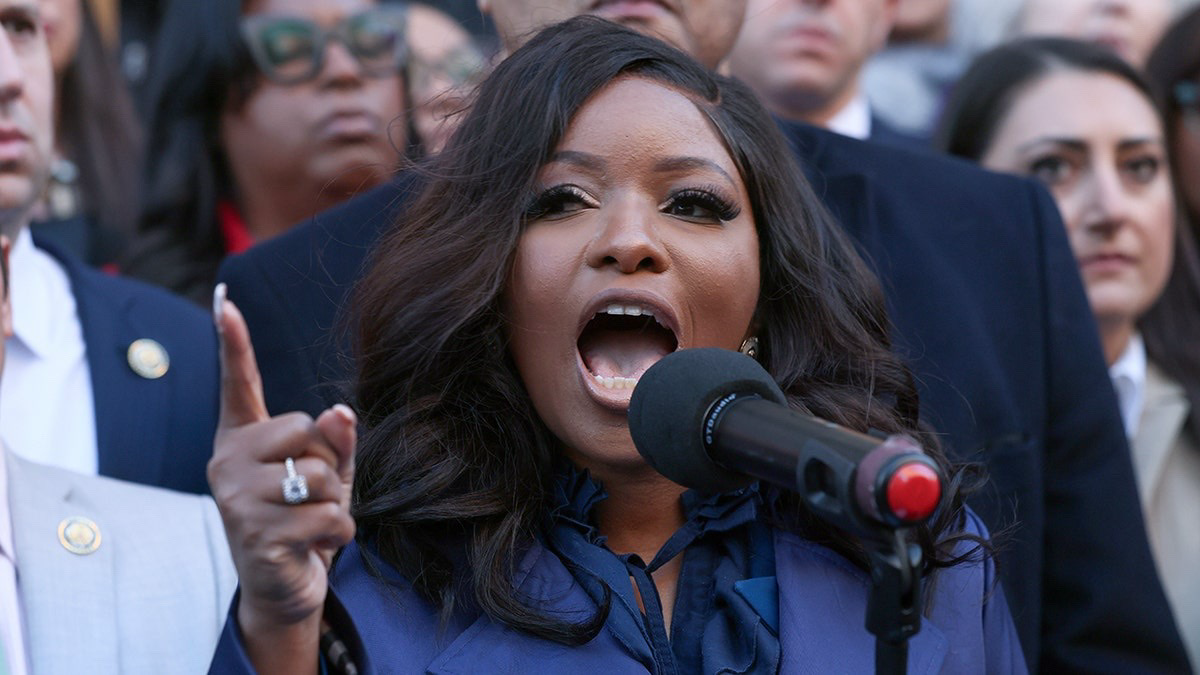
James Carville said the quiet part out loud about Rep. Jasmine Crockett’s Senate launch: she is breaking politics’ first rule by making the campaign about herself instead of the voters.
Carville’s warning is not about ideology. It is about incentives. He argued that winning elections is not “how many clicks you get” or “how much overnight fundraising you do,” but framing issues, understanding where people are coming from, and earning trust the hard way. That critique lands because Crockett’s rollout was built for viral attention, not persuasion.

Look at the opening message. Crockett launched her bid with a video centered on President Trump insulting her, a format designed to travel fast online and drive emotion, not to explain a governing plan for Texas. Even coverage that is otherwise friendly to Democrats has described the race as a split between a Trump focused approach and a voters first reset message. Carville is simply pointing out what many voters already feel in their gut: politics is turning into performance art.
And performance is Crockett’s brand. She is talented on camera. She is quick. She is combative. She has built a national following by being the face of conflict in a conflict driven era. But being good at generating attention is not the same as doing the hard work of legislating. Congress is committee rooms, markups, amendments, coalition building, and boring persistence. The country does not get safer or richer because a clip went viral.
Carville’s deeper point is that this kind of politics can become a treadmill. Once you are rewarded for outrage and applause lines, you start chasing the next hit. You start measuring success in views and donor pings. And you start treating a Senate campaign as the biggest stage yet.
That brings us to the money question. Crockett’s own federal filings show a fundraising machine that is heavily fueled by unitemized individual contributions, the kind that typically pours in through national online giving when a candidate is constantly in the spotlight. From Jan 1, 2025 to Sep 30, 2025, her authorized committee reported $6,560,239.14 in total receipts, with $4,939,220.75 in unitemized individual contributions. Politico also noted that her campaign is expected to leverage her high national profile and strong fundraising base.
None of this proves corruption. But it absolutely raises a fair suspicion about motivation. Is this campaign primarily built to win Texas, or to keep a national donor pipeline flowing? When the pitch is “look what Trump said about me,” the natural audience is not just Texans. It is coastal political culture, the New York and Los Angeles donor class, the activist email lists, and the people who want symbolic fights more than governing results.
That suspicion is amplified by the simple fact that a Texas Senate seat is one of the hardest climbs in American politics. Even some House Democrats are privately warning that Crockett could win a primary but struggle in a statewide general election because her style may alienate persuadable voters. Carville is saying the same thing in blunt language: campaigns are supposed to be about the voters.
Yes, Crockett is currently leading early primary polling. A Texas Southern University survey of 1,600 likely Democratic primary voters conducted Dec 9 through Dec 11, 2025 found Crockett at 51% and James Talarico at 43%, with 6% unsure. But early name recognition and early clicks are not the finish line. Texas is not a social media district. Texas is 30 million people, wildly diverse, and many of them are sick of politics as theater.
Carville is right to sound the alarm now, before Democrats nominate a candidate optimized for cable hits and donor blasts instead of persuasion and governance. Texas does not need a senator who treats public office like a stage. It needs someone who can do the unglamorous work: build coalitions, focus on affordability, crime, border security, jobs, energy, and the day to day concerns that actually shape family life.
If Crockett wants to prove Carville wrong, the answer is simple: stop auditioning for national attention, start campaigning like a Texas senator, and show voters a plan that is bigger than her own celebrity.

Leave a Reply