America’s Next Frontier Is Continental
The United States has always been more than a country on a map. It has been an argument about how free people should live, an argument that inspired others across oceans and continents. For most of our history, however, Washington has behaved as if our destiny lies everywhere except the place that matters most for our long term security and prosperity: our own shared hemisphere.
We poured blood and treasure into wars in Europe, quagmires in the Middle East, and balancing acts in Asia, while treating Latin America and the Caribbean as an afterthought or a problem to be managed. That era has to end. Not because the rest of the world no longer matters, but because we are neglecting the one strategic advantage no other great power can ever copy: a Western Hemisphere that could be friendly, free, and prosperous from Alaska to Patagonia.
China understands this better than we do. Beijing has spent two decades buying influence across the Americas with loans, ports, mines, space facilities, and research centers that conveniently double as listening posts. Trade between China and Latin America and the Caribbean passed $518 billion in 2024 and continues to grow, backed by nearly $10 billion in new credit lines announced in Beijing this year.
Russia and Iran piggyback wherever they can, playing spoiler and exploiting every vacuum we leave behind. In Venezuela, the Trump administration’s campaign of maritime strikes on narco vessels and the declaration that the airspace “above and surrounding” Venezuela should be treated as closed have triggered a full blown sovereignty fight. Caracas calls it a colonial threat. Beijing denounces it as interference and warns against turning Latin America into anything other than a zone of peace.
In other words, the contest for the hemisphere is no longer theoretical. It is happening right now.
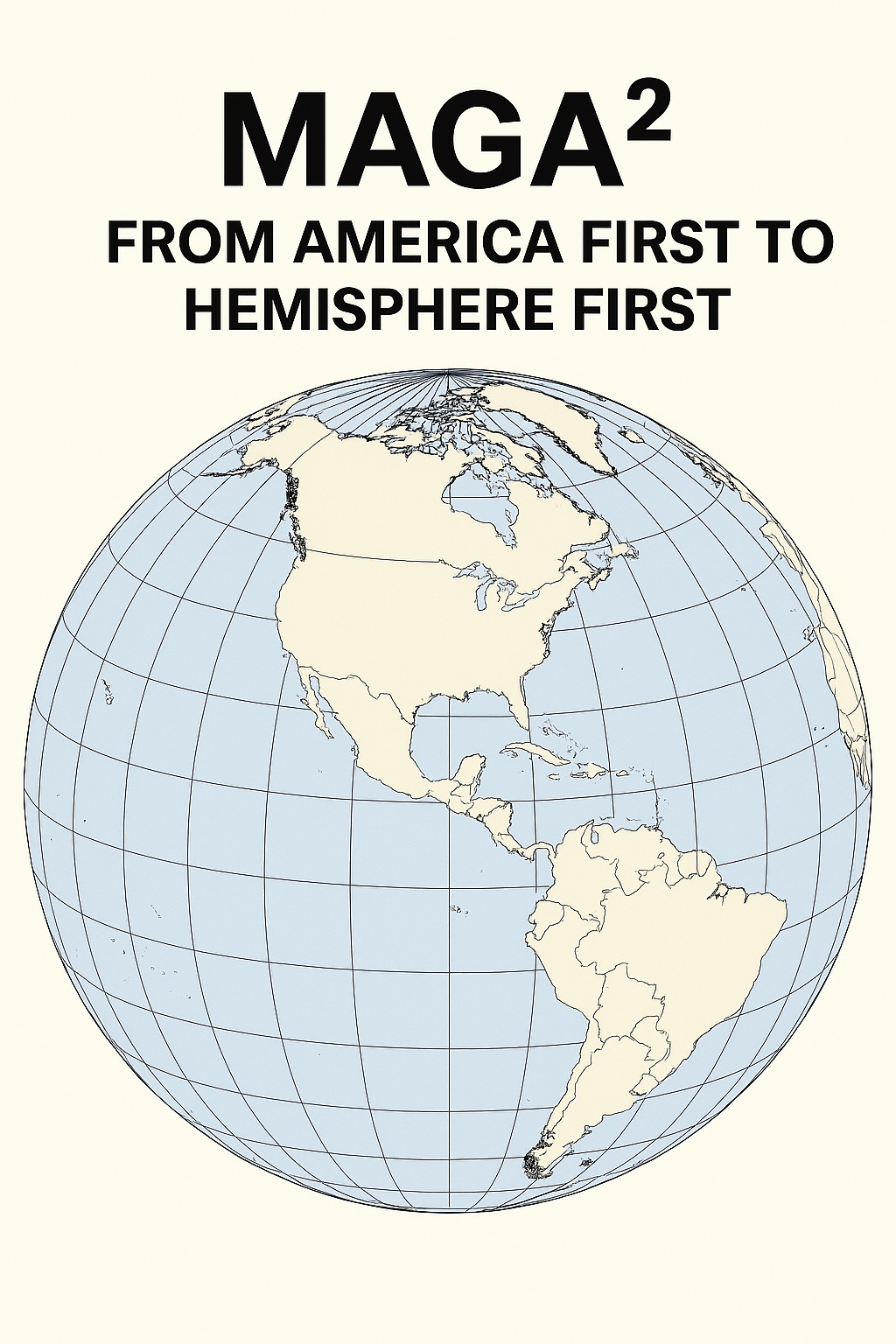
MAGA², Make America Great Again Squared, is the answer to that challenge. It is the evolution of America First into something bigger and stronger: Hemisphere First. It says that America’s greatness is maximized not by isolation or endless global crusades, but by leading a continental partnership of roughly thirty five sovereign nations built on prosperity, security, and freedom.
This is not globalism in new packaging. It is strategic realism on a continental scale.
⸻
From Monroe to MAGA²
In 1823, when the United States was still a young republic, President James Monroe drew a bold line. The Monroe Doctrine told European empires that the Americas were no longer open for colonization. No new imperial adventures. No return to the old order. The message was simple: the Western Hemisphere is not your chessboard.
For almost two centuries, that doctrine discouraged foreign encroachment. The old threats wore uniforms and flew royal flags. Today they arrive on corporate letterhead and state bank stationery. Loans become handcuffs. Ports become dual use naval facilities. Scientific cooperation becomes a convenient cover for intelligence collection.
Recent events have dragged this logic back into the open. Tensions over Venezuelan airspace, expanded United States maritime operations against drug vessels in the Caribbean, and China’s loud objections to Washington’s pressure on Maduro are all pieces of the same puzzle.
Monroe Doctrine 2.0 under MAGA² is not a history project. It is a statement of reality. It says to Beijing, Moscow, Tehran, and any other hostile regime: you will not turn the Americas into your forward operating base. And it says to our neighbors: you are not pawns, you are partners in a shared project of continental security.
MAGA² is not a break with American tradition. It is its update for the twenty first century.
⸻
Why Hemisphere First Is Inevitable
Look at the map, the numbers, and the culture, and one conclusion is unavoidable: the Americas are a natural power bloc that can outmatch any rival if we choose to act together.
Geography
North, Central, and South America form a single strategic system of land and sea. The Panama Canal links the Atlantic and Pacific. Sea lanes through the Caribbean and along both coasts carry enormous shares of global trade. If the countries of the hemisphere treat this as a common strategic space instead of a collection of separate stories, we together control the junction of the world’s oceans.
Demographics
Taken together, the Western Hemisphere holds a population a little above 1.05 billion people, based on current estimates for North and South America. China still has a larger population, around 1.4 billion, but it is aging rapidly.
By contrast, much of Latin America and the Caribbean remains relatively young. That means workers, innovators, and entrepreneurs. The demographic future of growth looks more West than East if we do not throw the opportunity away.
Economics
On nominal measures, the United States alone will produce about $28 trillion in output in 2025, while China will reach roughly $19.4 trillion. Add Canada, Mexico, Brazil, Argentina, and the rest of the Americas, and the Western Hemisphere’s gross domestic product pushes toward $40 trillion according to the International Monetary Fund’s regional data.
North America provides industrial strength, technology, and finance. South America supplies vast agricultural output, critical minerals, and energy. The Caribbean and Central America sit astride shipping lanes and data cables that connect continents. Coordinated, that is not just a big market. It is the largest integrated economic space on earth.
Military Power
The proposed United States defense budget for 2025 is about $850 billion in discretionary spending. Add the forces of Canada, Brazil, Mexico, Colombia, and others, and total hemispheric military spending easily clears $1 trillion each year.
China officially reports a defense budget around $246 billion for 2025. Independent estimates from Stockholm International Peace Research Institute suggest actual Chinese military spending is already above $300 billion and rising, but still far below the combined weight of the hemisphere.
In simple terms: if the Americas cooperate on defense, no external power can match what we can build and sustain.
Civilization and Culture
Unlike alliances slapped together on paper, the nations of the Americas share a recognizable civilizational backbone. Most of the region is shaped by Judeo Christian moral frameworks, democratic aspirations, and overlapping languages and traditions. There are real differences and tensions, but there is also a family resemblance you do not see when you compare Europe and East Asia, or the Middle East and East Africa.
That cultural overlap is not window dressing. It is the basis for real trust and long term cooperation.
⸻
What MAGA² Actually Looks Like
Talking about a hemispheric vision is easy. The hard work is turning it into concrete steps. MAGA² is not just a slogan. It is a program.
1. A Continental Economic Zone
The first pillar is economic. Take the existing United States Mexico Canada Agreement and expand its logic outward. The goal is a hemisphere wide economic framework that
• lowers tariffs and non tariff barriers inside the Americas
• simplifies customs and digital rules so a small business in Peru can sell into Texas or Quebec as easily as into its own capital
• prioritizes supply chains that run within the hemisphere, rather than through ports controlled by the Chinese Communist Party
If a factory in Mexico, a mine in Chile, a port in the Dominican Republic, and a technology firm in Florida all sit inside the same continental value chain, that is not offshoring to our enemies. It is reshoring to our friends.
2. A Human Capital and Education Compact
Power is not just steel and oil. It is brains. A Hemisphere First strategy would expand scholarship programs, joint universities, and research cooperation in areas like energy, cyber security, and biotechnology. It would also create clear and lawful migration pathways for skills and workers that the hemisphere needs.
That means a talented engineer from Colombia or Brazil can work with North American companies and universities without being forced into dangerous black markets. It means a student from Guatemala with a scholarship does not have to risk his life with a smuggler. Legal, orderly, merit based migration reduces chaos and builds loyalty.
3. A Hemispheric Security Architecture
MAGA² also implies a serious security pillar:
• joint naval and air exercises focused on maritime security, air defense, and disaster response
• shared intelligence on cartels, terrorist cells, foreign intelligence operations, and cyber attacks
• coordinated protection of critical infrastructure such as the Panama Canal, major ports, energy facilities, and undersea cables
This is not about American troops everywhere. It is about a common understanding that threats from outside the hemisphere, or from transnational criminal networks inside it, are everyone’s problem.
4. A Focus on the Caribbean and Central America
The weakest links are where adversaries test the chain. In our shared hemisphere, that often means the Caribbean basin and parts of Central America. Those are the places where Chinese companies seek port concessions, where Russian and Iranian operatives hunt for influence, and where cartels exploit fragile states.
A Hemisphere First policy would:
• invest in ports and airports that remain under the control of aligned governments
• help build secure fiber optic and fifth generation communication networks that do not depend on Chinese vendors
• support diversified energy projects that limit dependence on hostile petro states
Strengthen this southern and central belt and you strengthen the entire hemisphere.
⸻
What Our Partners Gain
This is not charity and it is not a lecture. It is a bargain.
Economic Muscle and Fairer Terms
Latin American and Caribbean nations often face a rigged game. Approach China or Europe alone, and you negotiate from weakness. As part of a hemispheric bloc anchored by the United States, Canada, Brazil, and Mexico, smaller economies gain leverage and options.
Brazil, Mexico, and Argentina would see their industrial exports feed into a larger, more predictable continental market. The Caribbean could tie its tourism, logistics, and financial services more tightly to North American demand, rather than to risky Chinese credit and opaque Belt and Road contracts.
Real Social Mobility, Not Just Promises
A Hemisphere First arrangement can channel investment into schools, vocational training, and digital skills in countries like Colombia, Peru, and the Dominican Republic. That means more opportunity at home and less compulsion to flee north.
Legal, structured worker programs for Central American and Caribbean citizens could fill labor gaps in North America, raise incomes, and starve the human smuggling networks that profit from chaos. Remittances would keep flowing, but domestic opportunity would grow too.
Collective Security and Deterrence
Most smaller states cannot stand alone against a major power that wants to buy key land, ports, or infrastructure. A hemispheric security pact changes that math. When China tries to acquire a strategic port or when Iran seeks another covert logistics hub, it is not a small island or one mid size republic saying no. It is an entire hemisphere.
Shared maritime patrols, cyber defense centers, and regional rapid response units make it more expensive for cartels and foreign intelligence services to operate. Everyone benefits from a neighborhood too strong to bully.
Concrete Case Studies
• Mexico consolidates its role as a manufacturing hub tightly integrated with both North and South America, raising wages and reducing pressure for mass migration.
• Brazil leverages its agricultural and mineral strength with preferential access to North American capital and technology, without mortgaging its future to Beijing.
• Chile and Argentina, rich in lithium and other critical minerals, become pillars of a hemispheric energy and battery strategy that does not leave us begging China for components.
• Caribbean nations see tourism and shipping gain resilience as United States and Canadian investment modernizes ports, airports, and energy systems.
⸻
Addressing the Hard Parts
Any serious vision must admit that integration will not be smooth.
Ideological divides are real. Brazil under Lula da Silva and Mexico under Claudia Sheinbaum are wary of anything that looks like a United States run project, even as they deepen economic ties with China and maintain large trade relationships with the United States.
Corruption and weak institutions in parts of Central America and the Caribbean scare off legitimate investors and open doors for Chinese state firms and transnational crime. Old resentments about past United States interventions still shape politics in many capitals.
There are also encouraging shifts. Argentina’s election of Javier Milei signaled a decisive break with an old leftist model and opened the door to a more market friendly and West facing orientation. Ecuador under Daniel Noboa has doubled down on a center right, pro business path. Bolivia has just moved away from the long dominance of Evo Morales’s movement and toward a more centrist government promising economic openness.
Chile appears poised for a sharp turn to the right in its upcoming election, with tough on crime and pro market candidates leading the polls.
The lesson from Europe’s post war integration is that you do not start with everyone. You begin with a core group of willing partners, build trust and institutions, and expand outward. For the Americas, that likely means using the USMCA as a starting platform, inviting countries such as Chile and Colombia into deeper trade and security arrangements, and engaging Brazil and Mexico not as followers but as co leaders in shaping the rules of the continental game.
Integrating a region as diverse as the Americas will never be neat. But the alternative is to let Beijing write the rules.
⸻
Monroe Doctrine 2 point 0: Drawing the Red Line
To make any of this real, we have to be brutally honest about the threat.
China already has stakes in major port projects, like the deep water terminal at Chancay in Peru, which analysts expect to become one of the largest hubs on the Pacific coast. In Argentina’s Patagonia region, the Espacio Lejano deep space ground station gives Beijing near total control over a critical facility with obvious dual use potential.
On top of that, Chinese companies and state lenders are tied into dozens of infrastructure projects across the region, from energy to telecom. More than twenty countries in Latin America and the Caribbean have signed on to the Belt and Road Initiative, even as the region captures only a small share of Chinese construction and investment flows.
Monroe Doctrine 2 point 0 under MAGA² lays down simple, non negotiable principles:
• no Chinese, Russian, or Iranian bases, troops, or intelligence facilities anywhere in the Americas
• no hostile power control over key ports, telecommunications networks, space assets, or critical mineral projects
• the United States and its partners reserve every diplomatic, economic, cyber, and if necessary military tool to prevent hostile encroachment
For friends, the doors of the largest market and strongest security network in the world are wide open. For adversaries, the hemisphere becomes a very expensive place to play games. Generous with friends, ruthless with enemies. That is how you protect a family of nations.
⸻
Learning from Europe and Avoiding the Belt and Road Trap
Skeptics will say that continental integration is messy and slow. They are right. But we already have an example.
In the years after the Second World War, six Western European nations painstakingly built a coal and steel community that evolved into the European Union. Today it is a twenty trillion dollar economy with hundreds of millions of citizens and a single market. If Europe, divided by many languages and centuries of bloodshed, could do that, the Americas can do at least as well.
Asia gives us the opposite lesson. China’s Belt and Road Initiative dangled easy money to countries from Sri Lanka to Pakistan. The bills came due in the form of lost ports, lopsided debt, and increasing political dependence on Beijing. In Latin America, Chinese trade is booming, but the region actually receives a relatively small slice of Belt and Road investment and construction, only about 1.14 percent of construction projects and less than one percent of total investment in the first half of 2025.
That is the trap: high exposure to China, low leverage over China.
MAGA² offers a third path. Neither isolation nor servitude, but a hemispheric alliance that stands on its own feet and deals with Beijing from a position of strength instead of dependency.
⸻
Sovereignty Multiplied, Not Surrendered
Critics will claim that a Hemisphere First doctrine means erasing national independence. The opposite is true.
When the United States sinks endless resources into fragile commitments far from home, we tie our fate to regions we do not control. When smaller American nations take on opaque loans from Chinese state banks, they tie their futures to contracts written in Beijing.
A hemispheric community is different. Each nation keeps its flag, its constitution, its elections, and its laws. What changes is that we agree on a few core principles:
• the hemisphere is not open for hostile powers to carve into spheres of influence
• economic development should be transparent, sustainable, and mutually beneficial
• security threats that target one nation are of concern to all
Brazil and Mexico in particular must be treated not as junior partners but as essential co leaders in shaping the rules of this new compact. Without them, Hemisphere First is a slogan. With them, it becomes a reality strong enough to set standards for the rest of the world.
That is not the abolition of sovereignty. It is sovereignty multiplied.
⸻
America’s Continental Destiny
MAGA² is a call for the United States to grow up as a superpower and get serious about where its real strengths lie.
Thirty five nations. A little more than 1.05 billion people. A combined economy around $40 trillion. Over $1 trillion in annual defense spending. Shared languages, linked histories, related cultures, and very real common interests.
On the other side stand regimes that would love to divide us and rule us. China, which already dominates much of South American commodity trade and is building ports and space stations in our shared hemisphere. Russia and Iran, which see Caracas as a convenient platform from which to weaken United States influence and test our resolve.
We can drift into a future where Chinese controlled ports, Russian intelligence hubs, and Iranian networks become fixtures of the Americas. Or we can choose a different path: a Hemisphere First strategy that secures our neighborhood, raises living standards from Alaska to Argentina, and turns the Western Hemisphere into the world’s engine of prosperity and freedom for the rest of this century.
This is not about rejecting America First. It is about squaring it. MAGA² means recognizing that America is strongest when our neighbors are not failed states, cartel playgrounds, or Chinese satellite regimes, but partners that stand with us.
The Trump administration’s early moves, from pressure on Maduro’s regime to new resource and trade deals aimed at reducing dependence on Chinese critical materials, are signals of what a Hemisphere First posture can look like in practice.
Now the question is whether Congress, business leaders, and citizens are willing to think continentally, not just nationally.
America’s destiny is not to preside over a collapsing global order while our own hemisphere slips away. America’s destiny is continental: to lead a Western Hemisphere that is secure, prosperous, and free.
The choice is ours, and the time to make it is now.
⸻
Key Metrics at a Glance
• Population of the Americas: a little above 1.05 billion people
• Population of China: about 1.4 billion people
• Western Hemisphere GDP: around $40 trillion in current prices
• China nominal GDP: about $19.4 trillion
• United States requested defense budget for 2025: about $850 billion
• Official Chinese defense budget for 2025: about $246 billion, with independent estimates of real spending above $300 billion



Leave a Reply